Scaling a Perfume Formula From Trial to Batch Production
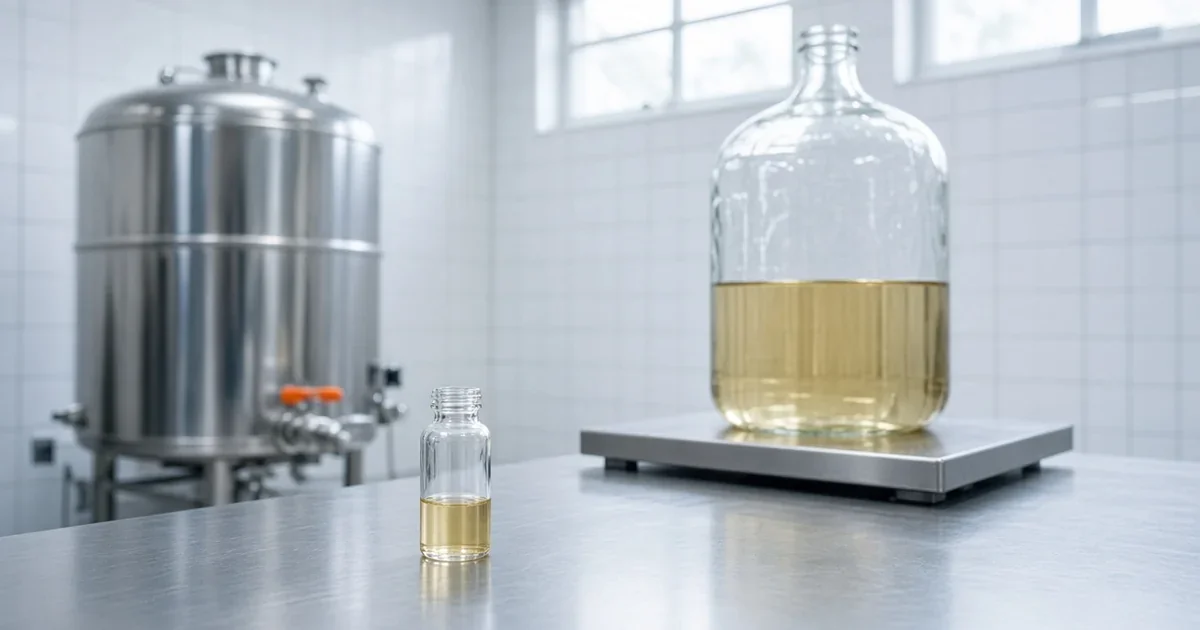
Your trial smells exactly right on blotter and skin. Now you want to make enough to fill real bottles, and suddenly the questions start. How many grams of each material? What happens to the line that was only a few drops? Why does the big batch smell slightly different from the little one?
Learning to scale a perfume formula properly is the bridge between a hobby and a product. The maths is simple, but the details around it (weighing, tiny quantities, rounding, losses and records) are where scaled batches drift away from the trial. This guide walks through the whole process, from a 10 g mod to a production batch you can repeat next month.
Why Percentages Are the Foundation of Scaling
A formula written in drops or millilitres can't be scaled reliably. Drop size changes with the pipette and the material, and volumes ignore density: a millilitre of thick resinoid and a millilitre of citrus oil don't weigh the same.
The fix is to express every formula as percentages by weight that add up to 100. Once you have that, the formula is scale-free. Ten grams, 100 grams or 5 kilograms are all the same perfume.
If your trial was made in drops, convert it first. Weigh each material as you add it (tare the scale, add the drops, record the weight), add up the total, then divide each weight by the total and multiply by 100. We cover the weighing side in more detail in our guide to perfume dilution and why you weigh, not drop.
The Core Calculation to Scale a Perfume Formula
With percentages in place, scaling uses one formula for every line:
Ingredient weight (g) = batch weight (g) × (ingredient % / 100)
Here's an example concentrate, written as percentages (example data, not a recommended recipe):
Bergamot oil: 18%
Hedione: 25%
Iso E Super: 20%
Lavender oil: 8%
Ambroxan 10% solution: 6%
Vanillin 10% solution: 5%
Galaxolide: 14.8%
Rose absolute 10% solution: 3%
Aldehyde C-12 MNA 1% solution: 0.2%
At a 10 g trial, those lines become 1.8 g, 2.5 g, 2.0 g, 0.8 g, 0.6 g, 0.5 g, 1.48 g, 0.3 g and 0.02 g.
At a 500 g batch, the same formula becomes 90 g, 125 g, 100 g, 40 g, 30 g, 25 g, 74 g, 15 g and 1 g.
The proportions are identical. What changes is how easy each line is to weigh accurately.
Check Your Smallest Line First
Look at the aldehyde line in the 10 g trial: 0.02 g. On a scale that reads to 0.01 g, that's two digits on the display, and a single extra drop can double it. In a trace material that's often enough to change the character of the opening.
Before you commit to a batch size, find the smallest line in the scaled formula and ask whether your scale can weigh it repeatably. If it can't, you have three options:
Make a larger batch, so the smallest line becomes a weighable amount. At 100 g, the aldehyde line is 0.2 g, which is far more manageable.
Pre-dilute the material (for example, take it from 1% down to 0.1% or from 10% to 1%) and enter the dilution as its own line in the formula, recalculating its percentage so the pure amount stays the same.
Use a more precise scale for trace lines. Many perfumers keep a 0.001 g balance for small additions and a higher-capacity scale for bulk materials and solvent.
Scaling up actually helps here: larger batches make tiny lines easier to weigh correctly.
Scale Up in Steps, Not One Jump
It's tempting to go straight from 10 g to a kilo. Resist it. A stepped approach, such as 10 g to 100 g and then to your production size, gives you a chance to catch problems while they're still cheap:
Make an intermediate batch (around 100 g is a common choice) using the exact production method you plan to use.
Evaluate it against the original trial on blotters and skin over at least a full day, so you smell the top, heart and dry-down.
Note any difference and investigate before changing the formula. Woods, musks and resins often need that full day to show their real balance.
Only then scale to production, once the intermediate batch smells like the trial.
If you do want to change the formula after the intermediate batch, save it as a new version rather than editing the old one. That way you always know which percentages produced which result.
Plan the Batch Around Your Bottles
A production batch should be sized from the end product backwards, not from a round number you like. Start with how many bottles you want to fill, then work out the finished liquid you need.
Because you'll be weighing, you need the weight of finished perfume per bottle. Ethanol is lighter than water (roughly 0.79 g per mL at room temperature) and your concentrate changes the density, so measure it: weigh a known volume of your intermediate batch.
Here's a worked example with illustrative numbers:
You want to fill 20 bottles of 50 mL.
Your measured fill weight is 41 g per bottle, so 20 bottles need 820 g of finished perfume.
You add a small overage for transfer losses, filtering and a retained reference sample. At 3%, that's about 25 g, giving roughly 845 g.
You round up to a convenient 850 g batch.
If your finished perfume is 18% concentrate in alcohol, the batch needs 153 g of concentrate and 697 g of alcohol (850 × 0.18 = 153; 850 − 153 = 697). You then scale the concentrate formula to 153 g using the same calculation as before. Not sure what concentration to choose? Our guide to perfume concentration percentages explains the usual ranges for EdT, EdP and parfum.
Round Honestly and Let the Carrier Absorb It
Scaled numbers are rarely neat. Rounding every line to whole grams looks tidy, but across 15 or 20 lines those small changes add up and shift the balance.
A more reliable approach:
Calculate every line to at least two decimal places.
Round only to the precision your scale can actually deliver for that line.
Let the solvent or carrier absorb the rounding difference so the total weight stays exact. A fraction of a gram more or less alcohol won't change the character of the perfume; a fraction of a gram of a powerful material can.
Whenever the amount you actually add differs from the target (a bottle ran out, a drop too many), write down the real weight. The batch record should describe the bottle you made, not the one you intended to make.
Order of Addition and Mixing
Order of addition isn't part of the percentages, but it affects how a batch comes together:
Add large solvents and high-dose materials first, so the smaller lines go into a liquid base rather than sitting on the bottom of an empty beaker.
Dissolve solids, resins and thick absolutes separately. Warm them gently with a portion of the solvent until clear, then return them to the main batch. Don't heat the whole batch to dissolve one material.
Stir until the concentrate is completely uniform before diluting it to the finished strength.
Evaluate the diluted product, not just the concentrate. A concentrate sniffed from the cap smells different from the alcohol solution that goes on skin.
Many perfumers also let the finished batch rest, then chill and filter it before filling. Treat your first production batches as a chance to define those steps and write them down.
Why a Scaled Batch Can Smell Different
If the big batch doesn't match the trial, check the process before rewriting the formula. The usual suspects are weighing errors in trace lines, evaporation of top notes while the batch sat open, too much heat, a different lot of a natural material, or comparing a fresh batch with a trial that had rested for weeks. Change the percentages only when you really want a different formula, and save it as a new version.
Keep a Batch Record You Can Repeat
The final step of scaling is the one most often skipped: writing down what happened. A good batch record includes:
The formula name and version used.
The batch date, total weight and a lot or batch number.
The target and actual weight of each material.
The supplier or lot of key materials, especially naturals.
Notes on haze, insolubles, substitutions, resting and filtering.
That record turns a perfume that "smelled right that time" into a product you can make again, and connects the batch to your stock levels and your cost per bottle.
This is exactly what the ScentLabs batch production tool is built for. Enter a target weight and it recalculates every line of your formula proportionally, so you can see the grams (and spot a tiny line) before you start weighing. When you log the batch, the materials are deducted from your inventory automatically, and each formula keeps its full production history, with batch dates, lot numbers, notes and QA comments. You can also export batch records to PDF to keep alongside your paperwork.
FAQ
How do I scale a perfume formula to a bigger batch?
Convert the formula to percentages by weight that add up to 100, then multiply your target batch weight by each ingredient's percentage and divide by 100. Every line scales by the same factor, so the proportions stay identical.
Why does my scaled-up perfume smell different from the trial?
The most common causes are weighing errors in very small lines, evaporation during weighing, overheating, a different lot of a natural material or a different resting time. Check the process before changing the formula.
What should I do if an ingredient is too small to weigh?
Make a larger batch so the line becomes weighable, pre-dilute the material and enter the dilution as its own line, or use a more precise scale for trace additions.
How much extra should I make for losses?
It depends on your equipment and process. Plan a small overage for transfer losses, filtering and a retained reference sample, then adjust it based on what you actually lose in your first few production batches.
Scale Your Formulas Without the Spreadsheet Maths
Scaling a perfume formula comes down to a simple rule applied carefully: work in percentages, check your smallest line, step up gradually, round honestly and record every batch. Do that, and your thousandth bottle will smell like your first trial.
If you'd like the calculations, stock deductions and batch history handled for you, try ScentLabs. The Free plan includes 25 materials and 10 formulas, so you can scale a real formula and log your first batches at no cost. When you need more room, Pro is US$5.99 a month and Lifetime is a one-off US$49.99. Create your free ScentLabs account and turn your next trial into a batch you can repeat.