EdP vs EdT vs Parfum: What Concentration Should Your Perfume Be?
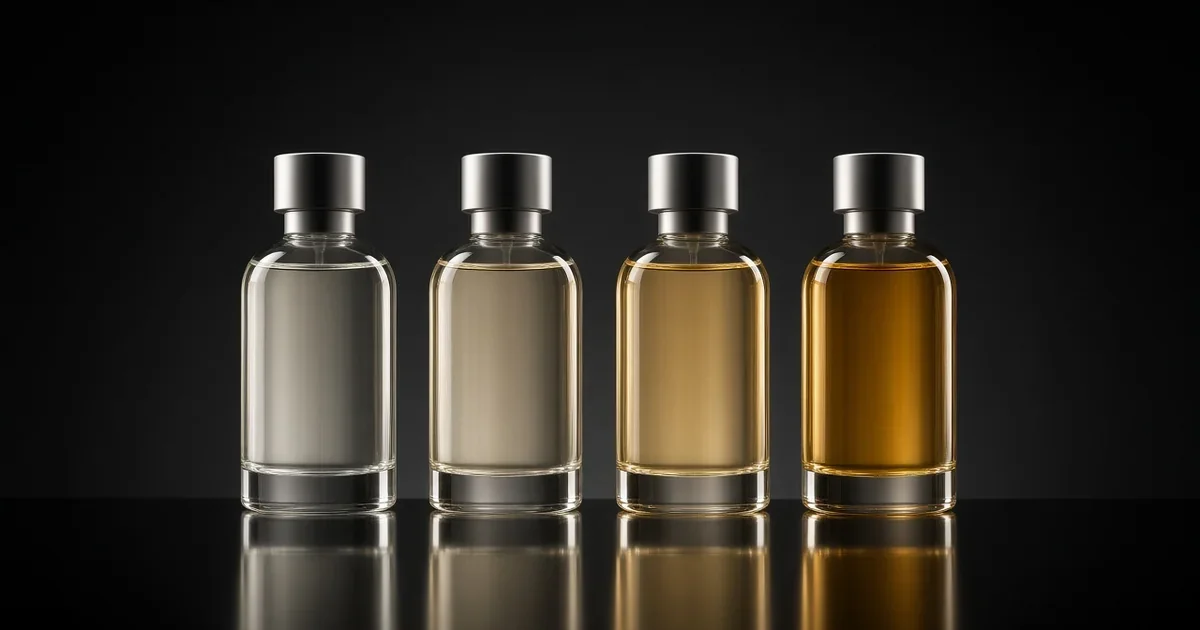
You've finished a fragrance concentrate you love. Now comes a decision that changes how it smells, how it wears, what it costs and what you can print on the label: how much of that concentrate goes into the bottle? Is it an Eau de Toilette, an Eau de Parfum, or something richer?
The perfume concentration percentage is one of the most searched topics in perfumery, and also one of the most misunderstood. The names sound like strict categories, but in practice they're conventions with ranges that overlap. This guide explains the typical ranges for each type, what concentration really changes (and what it doesn't), and how to pick and calculate the right strength for your own perfume.
What Is Perfume Concentration?
Perfume concentration is the proportion of fragrance concentrate in the finished product. The concentrate is your formula: the blend of naturals, aroma chemicals and bases you composed. The rest is the carrier, which in fine fragrance is usually perfumer's alcohol (ethanol), sometimes with a little water or other additives depending on the product.
So a perfume at 18% concentration contains about 18 parts of fragrance concentrate and 82 parts of carrier. Perfumers normally work by weight rather than volume, because materials have different densities and weighing is far more repeatable. If you need a refresher on why, our guide to perfume dilution and why you weigh instead of counting drops covers it in detail.
Typical Perfume Concentration Percentages by Type
There is no single global standard that defines these names, and different sources quote slightly different numbers. The ranges below are commonly cited reference points for alcohol-based fragrances:
Eau de Cologne (EdC): roughly 2% to 8% fragrance concentrate. Traditionally light, fresh and often citrus-led.
Eau de Toilette (EdT): roughly 4% to 15%. A lighter, more transparent format, very common in mainstream fragrance.
Eau de Parfum (EdP): roughly 8% to 20%. Today the most popular format for niche and designer launches.
Parfum / Extrait de Parfum: roughly 15% to 40%. The most concentrated alcohol-based format, often richer and closer to the skin.
Older references tend to quote lower figures (for example EdT at 4% to 8% and EdP at 8% to 15%), while many modern brands formulate at the higher end. That's why you'll see two perfumes labelled "Eau de Parfum" that differ a lot in strength.
Other formats worth knowing
Body mists and splashes: usually very low concentrations, often in the low single digits, sometimes with more water in the carrier.
Perfume oils: the concentrate is diluted in a carrier oil instead of alcohol. The alcohol-based ranges above don't automatically apply here.
Solid perfumes: the concentrate is set in a wax or butter base, again with its own formulation rules.
Why the Ranges Overlap
The overlap between EdT, EdP and Parfum isn't a mistake. These terms began as commercial conventions, and each fragrance house decides how it uses them. A brand might release a fresh citrus scent as an EdP at 12% and a heavy oriental as an EdT at 14%.
There's another reason: the same perfume name in two concentrations is often a different formula, not just more or less of the same concentrate. A brand may push the woods and resins in the Parfum version or brighten the top notes in the EdT. When you read "EdP vs EdT", think of them as related products, not simply strong and weak versions.
What Concentration Changes (and What It Doesn't)
It's tempting to assume that a higher perfume concentration percentage always means a longer-lasting, louder perfume. Reality is more nuanced.
What a higher concentration usually affects
Intensity on the skin. More concentrate generally means a denser, fuller impression, especially in the heart and base.
Cost per bottle. Concentrate is usually the most expensive part of a finished perfume, so every extra percentage point raises your material cost.
Compliance calculations. IFRA limits apply to the level of each material in the finished product, so raising the concentration raises the final level of every restricted material too.
Clarity and stability. Very high concentrations can be harder to keep clear and stable, depending on the materials you use.
What it doesn't guarantee
Longevity. How long a perfume lasts depends heavily on its structure. A citrus-heavy formula at 25% can fade faster than a woody-musky one at 12%.
Projection. Some materials project strongly even at low levels, while dense bases can sit close to the skin at high concentrations.
Quality. A higher concentration is not a better perfume. It's a different balance.
How to Choose the Right Concentration for Your Perfume
Instead of starting from the label you want, start from the formula you have. These questions help you find the right range.
1. What is the character of your fragrance?
Fresh citrus, aromatic and aquatic compositions are often made at lower concentrations, where they feel bright and airy. Ambery, woody, gourmand and resinous compositions often suit higher concentrations, where their depth comes through. This is a starting point, not a rule.
2. How strong are the materials you used?
A formula built around powerful materials (some musks, ambery woods or intense naturals) can feel loud even at a modest concentration. A formula of soft, delicate materials may need more concentrate to have presence. Trust your nose more than the category name.
3. What price point are you aiming for?
Because concentrate drives cost, the concentration percentage has a direct impact on your margins. An extra 5% of concentrate in a 50 ml bottle adds up fast across a full batch. Our guide to calculating perfume formula cost shows how to work out cost per gram and per bottle before you decide.
4. What will you call it?
If your formula works best at 16%, "Eau de Parfum" is a natural name. If it works best at 9%, "Eau de Toilette" or "Eau de Parfum" could both be reasonable depending on the convention you follow. Be consistent across your range and honest with your customers about what each name means for your brand.
Test Before You Commit
The most reliable way to choose a concentration is to make a small series of test dilutions and compare them over time. A practical approach:
Make three or four versions of the same concentrate at different strengths, for example 10%, 15%, 20% and 25%.
Label each one clearly with the formula, version and percentage.
Let them rest for a while before judging, since a fresh mix often smells different from a matured one.
Test on blotters and on skin, noting the opening, the heart after an hour and the dry-down several hours later.
Ask others to smell them without telling them the percentage.
You'll often find a sweet spot where the formula feels balanced, and going higher only adds weight without adding beauty.
How to Calculate a Batch at a Given Concentration
Once you've chosen a percentage, the maths is straightforward when you work by weight:
Concentrate needed = total batch weight x target concentration
Carrier needed = total batch weight - concentrate needed
For example, for a 100 g batch of Eau de Parfum at 18%:
Concentrate: 100 g x 0.18 = 18 g
Alcohol: 100 g - 18 g = 82 g
If you want to fill bottles by volume, measure the density of your finished blend or fill a test bottle on the scale, then convert. And remember that if your concentrate contains diluted materials (for example a material used as a 10% solution), the true amount of pure material in the finished perfume is lower than the raw weights suggest. That matters for both strength and IFRA calculations.
How ScentLabs Helps With Perfume Concentration
Keeping track of concentrations across formulas, versions and dilutions is where spreadsheets get messy. The ScentLabs formula creator lets you set a concentration percentage for each ingredient and computes the effective pure material contribution of every diluted ingredient, so you see the real composition of your formula. You can also:
Version your formula to compare an EdT and an EdP variant side by side, with a full changelog.
Auto-scale percentages when you change batch sizes.
Check IFRA usage limits against the integrated IFRA database.
Calculate costs and margins so you see how each concentration affects your price.
Visualise the olfactive pyramid to understand how top, heart and base notes are balanced.
Frequently Asked Questions
What is the perfume concentration percentage of an Eau de Parfum?
Eau de Parfum is commonly made with roughly 8% to 20% fragrance concentrate, with many modern brands working in the mid-to-high part of that range. There's no single legal definition, so brands vary.
Is EdP stronger than EdT?
Usually, an EdP contains more concentrate than an EdT of the same fragrance, so it often feels fuller. But the ranges overlap, and the two versions are frequently different formulas, so one isn't always simply a stronger version of the other.
Does a higher concentration make a perfume last longer?
Not necessarily. Longevity depends mainly on the materials and structure of the formula. Higher concentration can help, but a fresh citrus formula will still fade faster than a woody or musky one.
Should I use weight or volume to dilute my perfume concentrate?
Weight. Weighing on a precise scale is more accurate and repeatable than measuring volume, because materials and alcohol have different densities.
Do IFRA limits change with concentration?
The limits themselves don't change, but they apply to the finished product. If you raise the concentration of your perfume, every restricted material ends up at a higher level in the final product, so you should check compliance at the concentration you actually sell.
Find the Right Strength for Your Formula
Choosing a perfume concentration percentage is part science and part taste. Start from the typical ranges, test a few strengths side by side, check your costs and IFRA levels at the final concentration, and pick the version that best expresses your idea.
If you'd like your formulas, dilutions, versions and costs in one place instead of across scattered spreadsheets, try ScentLabs for free. The Free plan includes 25 materials and 10 formulas, with no credit card required. When you need more, Pro costs US$5.99 per month and Lifetime is a one-off US$49.99. Create your free ScentLabs account and start formulating.