Perfume Dilution Explained: 1%, 10% Solutions and Why You Weigh, Not Drop
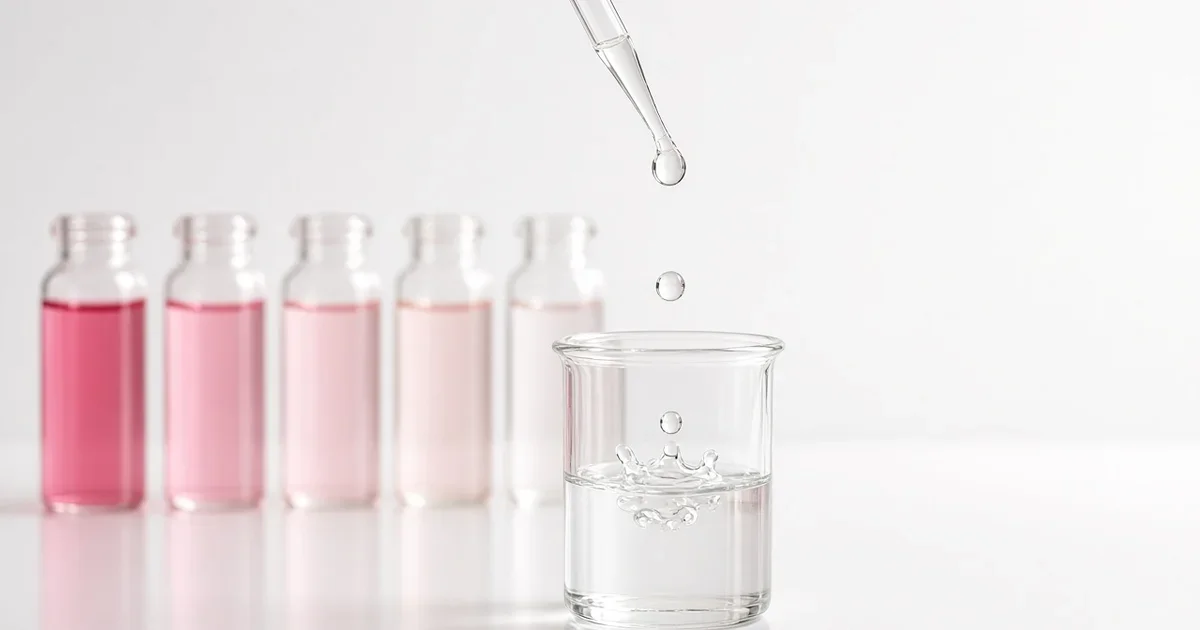
Every perfumer has a shelf of little bottles labelled "10%" or "1%". They look like a convenience, but they are really a measuring tool, and when the maths behind them goes wrong, the whole formula goes wrong with it, usually without anyone noticing.
This guide explains what a perfume dilution really is, the one formula that sits behind every perfume dilution calculator, how to make 10% and 1% solutions step by step, and how to count those dilutions correctly inside a formula. We will also cover why weighing beats counting drops, every single time.
What Is a Perfume Dilution?
A dilution is a fragrance material mixed with a solvent at a known strength. When perfumers say "a 10% solution of vanillin", they mean that 10% of the finished solution's weight is vanillin and the other 90% is solvent.
Two details in that sentence matter:
Of the finished solution. The percentage refers to the total weight of the bottle's contents, not to the weight of solvent you add.
By weight. Perfumery works weight for weight (often written w/w). Grams, not millilitres and not drops.
Why perfumers dilute materials at all
There are three practical reasons to keep dilutions on your organ:
Accurate weighing of tiny amounts. Many powerful materials are used in traces. Every balance has a minimum weight below which its reading is not reliable (check your scale's specification sheet). Weighing ten times more of a 10% solution turns an unreliable reading into an honest one.
Honest evaluation. Some materials smell harsh, flat or even unpleasant neat, and only show their real character once diluted.
Handling solids and very viscous materials. Crystals, resinoids and thick bases are far easier to dose accurately once they are dissolved in a solvent.
The Formula Behind Every Perfume Dilution Calculator
Whatever tool you use, the maths is the same. To make a solution from a neat (100%) material:
Material (g) = total weight (g) x target % / 100
Solvent (g) = total weight (g) - material (g)
If you are starting from an existing dilution instead of the neat material (a "stock" solution), the first line becomes:
Stock solution (g) = total weight (g) x target % / stock %
Solvent (g) = total weight (g) - stock solution (g)
That's it. A perfume dilution calculator is simply these two lines wrapped in a form, but knowing them means you can check any result in your head.
How to Make a 10% Dilution, Step by Step
Let's make 10 g of a 10% solution from a neat material.
Material = 10 x 10 / 100 = 1 g
Solvent = 10 - 1 = 9 g
On the bench:
Place a clean, labelled bottle on the scale and tare it.
Weigh in 1.00 g of the material.
Tare again (or note the reading) and add solvent until the total reaches 10.00 g.
Cap, mix well and let solids dissolve fully before you use it.
The classic mistake: adding 10 g of solvent
It is very tempting to weigh 1 g of material and then add 10 g of solvent. That gives you 11 g of solution containing 1 g of material, which is 1 / 11 = 9.09%, not 10%. The error looks small, but it gets copied into every formula that uses the bottle and grows if you dilute that solution again. Always make up to the total weight.
How to Make a 1% Dilution (and Step Down From a Stock)
You can make a 1% solution directly from neat material, but for 10 g you would need just 0.1 g of material, which is exactly the kind of tiny weighing dilutions are meant to avoid. It is usually more accurate to step down from your 10% stock.
To make 10 g at 1% from a 10% stock:
Stock solution = 10 x 1 / 10 = 1 g of the 10% solution
Solvent = 10 - 1 = 9 g
That 1 g of stock contains 0.1 g of material, so the new bottle is 0.1 / 10 = 1%. You get the same result as weighing 0.1 g of neat material, but with a weighing your balance can actually handle.
The same logic works for any strength. For 20 g at 5% from neat material, weigh 1 g of material (20 x 5 / 100) and 19 g of solvent. For 50 g at 0.1% from a 1% stock, weigh 5 g of the 1% solution (50 x 0.1 / 1) and 45 g of solvent.
Why You Weigh, Not Drop
Most of us start in drops because droppers come with the bottles. The problem is that a drop is not a unit of measurement. Its size depends on:
The viscosity and surface tension of the liquid (a thick resinoid makes a heavier drop than a thin citrus oil)
The size and shape of the dropper or pipette
How hard you squeeze, the angle you hold it at and how full it is
The temperature of the room and of the material
Volume is not much better. Fragrance materials have different densities, so 1 ml of one material does not weigh the same as 1 ml of another. A formula written in millilitres will drift as soon as you swap one material for another.
Grams, on the other hand, are reproducible by anyone, on any balance, at any time. They are also the basis of almost every rule you will deal with, including IFRA limits, which are expressed as a percentage by weight. A formula written in drops is a note about one afternoon; a formula written in grams is something you can repeat, scale and sell.
Choosing a Solvent for Your Dilutions
The solvent matters as much as the percentage, because it travels into every formula the dilution goes into. Common choices include:
Perfumer's alcohol (ethanol): evaporates along with the fragrance, so it shows a material's development close to how it will behave in a finished alcohol-based perfume. Handy for evaluation on blotters.
DPG (dipropylene glycol): nearly odourless and very slow to evaporate. A popular choice for stock solutions, though it stays on a smelling strip and can soften top notes.
IPM (isopropyl myristate) and TEC (triethyl citrate): alternatives for materials that do not dissolve well elsewhere, or for products where you want to avoid DPG.
Counting Dilutions Correctly in a Formula
This is where most errors hide. When you add 2 g of a 10% solution to a formula, you are not adding 2 g of material. You are adding:
0.2 g of material (2 x 10 / 100)
1.8 g of solvent
If you record the whole 2 g as material, your formula overstates that material ten times. Its percentage looks ten times higher than it is, and its IFRA check reads ten times over the real value. If you ignore the solvent instead, the total weight of the blend is wrong and every other percentage shifts.
A worked example
Imagine a 20 g concentrate that includes 0.5 g of a material at 10% dilution. Its real contribution is 0.05 g of neat material, which is 0.05 / 20 = 0.25% of the concentrate, not 2.5%. The remaining 0.45 g is solvent that also belongs in your total.
If that concentrate then goes into a finished product at, say, 20%, the material is 0.25 x 20 / 100 = 0.05% of the finished product. That final figure, based on the neat material, is what you compare against IFRA limits for your product category. Our guide to IFRA standards for indie perfumers explains how those limits and categories work.
Labelling and Record-Keeping
A bottle marked only "10%" is close to useless a year later. Ten percent of what, in what, and made when? Every dilution should carry:
The material name (and supplier, if you stock more than one)
The solvent
The strength and basis, for example "10% w/w"
The date it was made
The lot or batch number of the material you diluted
Let Software Do the Dilution Maths
Hand calculations work, but they are fragile once a formula has dozens of materials at different strengths. In the ScentLabs formula creator, each ingredient in a formula can have its own concentration percentage, and ScentLabs computes the effective pure material contribution of every diluted ingredient. You see the real composition of your formula, and the IFRA compliance check works from usage limits rather than from guesswork. If you are still comparing tools, our roundup of the best perfume formulation software covers the main options.
FAQ
How do I make a 10% perfume dilution?
Weigh 1 part material and 9 parts solvent by weight, for example 1 g of material and 9 g of solvent for 10 g at 10% w/w. Do not add 10 g of solvent to 1 g of material, because that makes about 9.09%.
How do I make a 1% dilution from a 10% solution?
Use 1 part of the 10% solution and 9 parts solvent by weight. For 10 g at 1%, weigh 1 g of the 10% solution and add 9 g of solvent.
Can I use drops instead of grams?
Only for rough personal experiments. Drop size changes with the material, the dropper, your technique and the temperature, so a formula in drops cannot be reproduced reliably, scaled or checked against IFRA limits. Weigh whenever you want a result you can repeat.
What is the best solvent for perfume dilutions?
It depends on the job. Perfumer's alcohol is good for evaluating materials as they would behave in an alcohol-based perfume, while DPG is a common, nearly odourless choice for stock solutions. IPM and TEC are alternatives for materials or products where those do not suit.
Do IFRA limits apply to the diluted or the neat material?
IFRA limits refer to the concentration of the material itself in the finished product, so you need to count only the neat material inside your dilutions. That is why tracking each ingredient's dilution percentage matters.
Start Formulating With Accurate Dilutions
Dilutions are one of the simplest tools in perfumery, and one of the easiest to get wrong. Weigh everything, make up to the total weight, label every bottle and count only the neat material when you check a formula.
If you would rather not redo that maths for every trial, try ScentLabs. The Free plan includes up to 25 materials and 10 formulas, with per-ingredient dilution tracking built in. When you need more, Pro is US$5.99 a month and Lifetime is a one-off US$49.99. Create your free ScentLabs account and build your next formula on solid numbers.