IFRA Standards Explained for Indie Perfumers (51st Amendment)
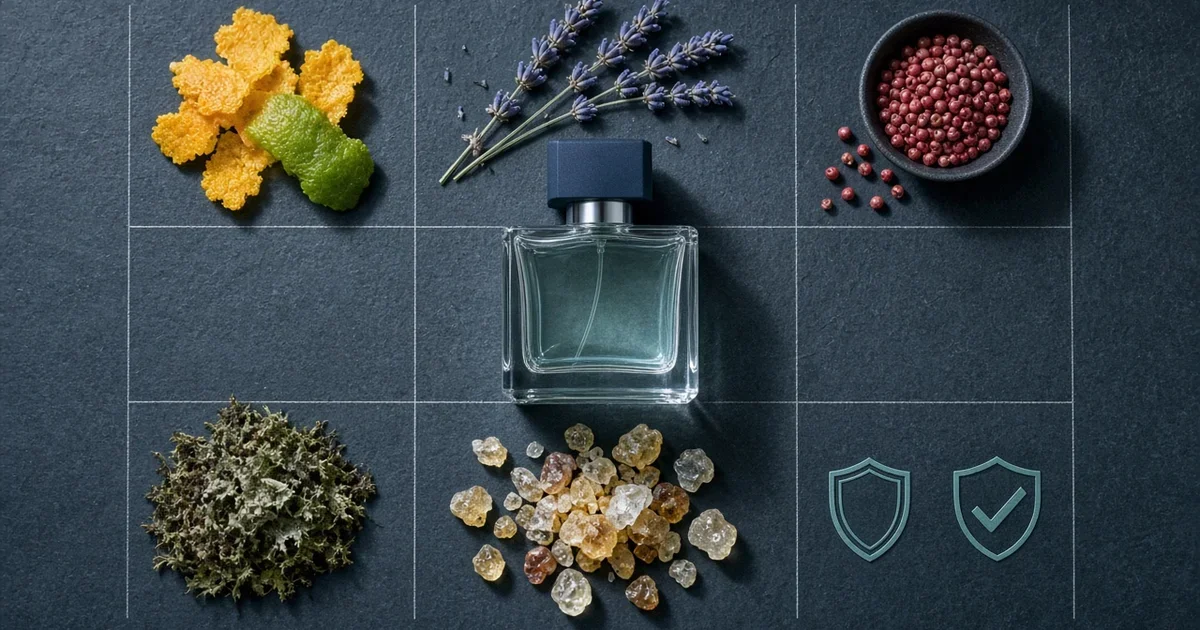
The first time a stockist or customer asks whether your perfume is "IFRA compliant", it can feel like a pop quiz in a language you never studied. You know your formula inside out, but categories, maximum concentrations and certificates of conformity? Not so much.
The good news is that the IFRA standards follow a clear logic once you see how the pieces fit. Below we explain what they are, how the 51st Amendment works, how limits apply to a real formula, what a Certificate of Conformity is (and isn't), and what the upcoming 52nd Amendment means for you.
Not legal advice. This article is a general introduction based on information published by IFRA at ifrafragrance.org, checked in October 2026. Always read the official standards and guidance, and check the regulations in every market where you sell.
What Are the IFRA Standards?
The International Fragrance Association (IFRA) describes its Standards as a globally recognised risk management system for the safe use of fragrance ingredients. Each one is based on a safety assessment by the Research Institute for Fragrance Materials (RIFM), reviewed by the independent Expert Panel for Fragrance Safety.
Standards are only set where risk management is needed, so most of your palette carries no IFRA Standard at all. The materials that do, including many essential oils through their constituents, can shape a formula.
Industry self-regulation, not law (in most places)
The IFRA Standards are part of the IFRA Code of Practice, the fragrance industry's self-regulatory programme. They are compulsory for IFRA members, who IFRA says account for around 80% of global fragrance production by volume, and voluntary for everyone else.
They sit alongside the law, not in place of it. You still have to follow the rules where you sell, such as the EU Cosmetics Regulation and its fragrance allergen labelling requirements, and the two don't always match: IFRA itself points to Lilial (BMHCA), banned in EU cosmetics since March 2022 but still permitted in some other markets.
The Three Types of IFRA Standards
Each Standard is one or more of three types:
Prohibition: the material should not be used as a fragrance ingredient, in any product, including those that never touch skin.
Restriction: the material may only be used up to a maximum level, which usually varies by product category.
Specification: the material may only be used if it meets set criteria, such as purity limits or a defined production process.
Restrictions are the ones you'll meet most often, and the limit is a maximum concentration in the finished consumer product, not in your fragrance concentrate.
The IFRA 51st Amendment: Key Dates
IFRA updates its Standards through numbered Amendments. The 51st, current at the time of writing, was notified on 30 June 2023 and came into force in stages:
Prohibitions, new creations: 30 August 2023
Prohibitions, existing creations: 30 July 2024
Restrictions and specifications, new creations: 30 March 2024
Restrictions and specifications, existing creations: 30 October 2025
All of these dates have now passed, so the 51st Amendment applies in full to both new and existing creations.
New creations vs existing creations
An existing creation is a fragrance mixture already on the market or in development when the Amendment's information exchange period ended; a new creation is one briefed after that. Existing products simply got longer to reformulate. The dates refer to fragrance mixtures leaving the fragrance house, not to finished products already on shelves.
IFRA Categories: Where Does Your Product Fit?
Limits depend on how a product is used, because a lip balm, a perfume and a candle expose people to very different amounts of fragrance. Under the 51st Amendment, products are grouped into 12 IFRA categories, several of which are split into sub-categories (5A to 5D, 7A and 7B, 10A and 10B, 11A and 11B). A few examples:
Category 1: products applied to the lips.
Category 2: products applied to the underarms, such as deodorants. Body sprays and mists can also fall here rather than in Category 4.
Category 4: products related to fine fragrance, such as eau de parfum, eau de toilette and cologne.
Category 5A: body lotions and other leave-on body products applied with the hands.
Category 9: rinse-off body and hand products, such as soap and shower gel.
Category 12: products not intended for direct skin contact, such as candles.
The skin sensitisation limits behind these categories use Quantitative Risk Assessment (QRA2), introduced with the 49th Amendment, which considers aggregate exposure across everyday products. If a product has more than one intended use, IFRA's guidance is to apply the lowest limit. The full list of product types is in IFRA's Guidance for the Use of the IFRA Standards.
How IFRA Limits Work in a Real Formula
Because restrictions apply to the finished product, you need two numbers: the percentage of the material in your concentrate and the percentage of concentrate in the final product.
Take a hypothetical example (the figures below are invented for illustration, not real IFRA limits):
A restricted material makes up 2% of your fragrance concentrate.
You dilute the concentrate to 20% in alcohol for an eau de parfum.
The material is therefore 2% x 20% = 0.4% of the finished perfume.
If its Category 4 limit were 0.5%, you'd be within it. In another product, at another dose or with a lower category limit, the answer could change.
Two things make it harder than it looks:
Dilutions: if you weigh 10 g of a 10% dilution, only 1 g is the material itself. Count the pure material, not the weight of the dilution.
Hidden contributions: restricted substances count whether added directly or through another ingredient. Naturals often contain restricted constituents (citral, for example, occurs in lemongrass oil). IFRA's Annex on contributions from other sources gives indicative levels; your supplier's data is better.
The IFRA Certificate of Conformity
An IFRA Certificate of Conformity is a document in which the maker of a fragrance mixture confirms that it meets the IFRA Standards for a specified intended use. Key points:
IFRA doesn't issue certificates, and no company issues them on its behalf, although IFRA lists third-party providers that can help.
IFRA provides a template that anyone familiar with the Standards can use, including non-members.
They're for mixtures, not raw materials. For a single raw material, suppliers communicate its conformity with the relevant Standard in a different format.
A certificate isn't a safety assessment, and it doesn't replace legal requirements in your market.
Also avoid calling your products "IFRA certified" or using the IFRA logo: IFRA doesn't certify products, says such claims can be misleading, and requires written authorisation to use its logo.
What About the 52nd Amendment?
IFRA consulted on the 52nd Amendment from 12 December 2025 to 12 June 2026 and published its End of Consultation Letter on 31 August 2026. According to IFRA, it will introduce 48 new restriction Standards addressing dermal sensitisation and revise 15 existing ones, along with changes on phototoxicity and furocoumarins in naturals.
The final Standards haven't been notified yet. IFRA expects the formal Notification in January 2027; the Standards will then enter into force 11 months later for new creations and 30 months later for existing ones. Until then, the 51st Amendment remains the reference, so keep good records of each formula to recheck quickly once the 52nd is published.
An IFRA Standards Checklist for Indie Perfumers
Before you sell a new perfume:
Identify the product category for every product the fragrance will go into.
List every restricted or prohibited material in the formula, including constituents of naturals.
Calculate finished-product levels, accounting for dilutions and the final concentration.
Compare against the current amendment using IFRA's online Standards Library and guidance.
Collect supplier documentation, such as safety data sheets and IFRA information for raw materials and bought-in compounds.
Check local regulations, including labelling, in each market where you sell.
Keep records so you can recheck when a new Amendment arrives.
Checking IFRA Standards in ScentLabs
Doing this by hand in a spreadsheet gets error-prone fast. ScentLabs includes an IFRA compliance checker designed for this step:
Select a product category for your formula, such as fine fragrance, body lotion or candle.
ScentLabs cross-references each material's percentage against the current IFRA limits for that category.
Materials over their limit are flagged in red, with the allowed maximum shown.
You get a recommended maximum usage percentage per material and a compliance report you can export to PDF.
Checks are updated as new IFRA amendments are released.
Like any tool, it's only as good as the material data you enter, so keep checking supplier documents and the official standards. The IFRA compliance checker is included in the Pro (US$5.99/month) and Lifetime (US$49.99 one-time) plans. Comparing options? Our guide to the best perfume formulation software covers how each tool handles IFRA.
Frequently Asked Questions
Are IFRA standards a legal requirement?
Not in most places. They're a voluntary, self-regulatory programme, compulsory for IFRA members. You must still follow the regulations of each market where you sell.
What is the current IFRA amendment?
As of October 2026, the 51st Amendment, notified in June 2023. IFRA expects to notify the 52nd in January 2027, with transition periods before it applies.
What IFRA category is perfume?
Fine fragrances such as eau de parfum, eau de toilette and cologne belong to Category 4. Body sprays and mists can fall under Category 2, so check IFRA's guidance.
Do I need an IFRA certificate to sell perfume?
IFRA doesn't issue certificates, and a certificate doesn't replace the legal requirements in your market. Business customers may ask for one, and you can prepare one using IFRA's template. Check what your market and customers require.
Do IFRA standards apply to candles?
Yes. Candles fall under Category 12 (no direct skin contact). Restricted materials have their own limits for that category, and prohibitions apply to every product type.
Try ScentLabs Free
Getting your formulas into a proper system is the first step to checking them against the IFRA standards. Create a free ScentLabs account to build up to 10 formulas with 25 raw materials and see their costs calculated, with no credit card required. When you're ready to run IFRA compliance checks, upgrade to Pro or Lifetime.
Facts checked against ifrafragrance.org in October 2026. This article is general information, not legal or regulatory advice. Always confirm against the current IFRA Standards and the regulations in your market.