Perfumery Raw Materials List: Essentials for Your First Organ
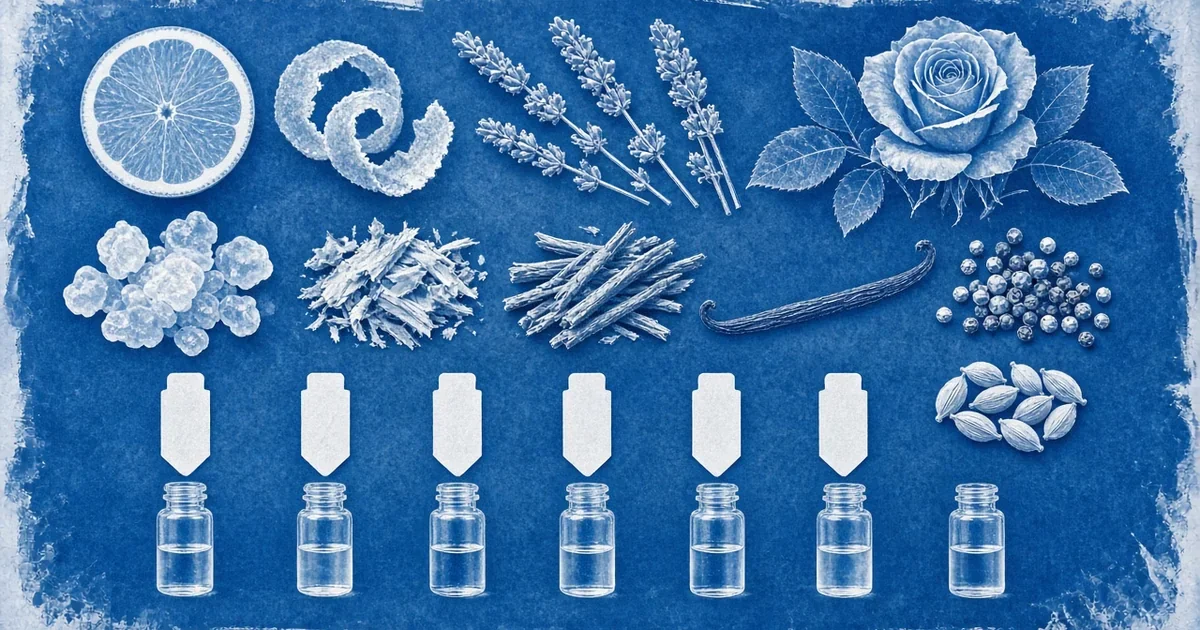
Open any supplier's catalogue for the first time and it's easy to freeze. There are thousands of essential oils, absolutes, resins and aroma chemicals, many with names that tell you nothing about how they smell. Buy at random and you end up with a shelf of expensive bottles that don't work together.
The good news: you don't need a huge collection to make real perfume. Most educators suggest starting with roughly 15 to 30 well-chosen materials, then growing slowly as your nose and your formulas develop. This perfumery raw materials list gives you a practical starting point, sorted by role, with notes on dilution, safety and how to keep your organ organised from day one.
A quick note on safety. Typical dilutions and restrictions below are general guidance, not rules. Always check your supplier's safety data sheet and IFRA certificate for each material before you use it in anything you wear or sell.
What Is a Perfumer's Organ?
A perfumer's organ is simply your working collection of raw materials, traditionally arranged in tiers around the workbench like the keys and stops of a musical organ. In a large fragrance house, it can hold well over a thousand materials. For an indie perfumer, it's usually a few shelves or a drawer of small bottles.
What matters isn't size but coverage. A good starter organ gives you at least a couple of options in each family (citrus, green, floral, herbal, spicy, woody, resinous, musky and sweet) so you can build complete accords without gaps. It should also mix naturals with aroma chemicals. Naturals bring richness and complexity; aroma chemicals bring structure, diffusion, longevity and consistency, often at a lower cost.
How to Use This Perfumery Raw Materials List
The materials below are grouped by where they usually sit in a fragrance pyramid. If you need a refresher on that structure, our guide to building a balanced fragrance pyramid explains how top, heart and base notes work together.
Keep in mind that these categories are loose. Many materials sit between tiers, and how long something lasts on a smelling strip depends on the material, the grade and the dilution. You don't need every item on the list. Pick two or three from each section to start, and choose ones whose smell you genuinely like.
Top Notes: Citrus, Fresh and Green Materials
Top notes are what you smell first. They're bright and volatile, and most fade within minutes to a couple of hours.
Bergamot (FCF grade). The classic citrus of colognes and many modern fragrances: fresh, slightly floral and bitter. Look for the FCF (furocoumarin-free) grade, because furocoumarins in ordinary cold-pressed bergamot can cause phototoxic skin reactions and are restricted by IFRA in leave-on products.
Lemon or sweet orange. Bright, juicy and inexpensive. Like bergamot, some cold-pressed citrus oils carry phototoxicity restrictions, so check the supplier's documents for your grade.
Petitgrain. Distilled from the leaves and twigs of the bitter orange tree. Woody-green and citrusy, and it tends to last longer than most citrus oils.
Dihydromyrcenol. An aroma chemical with a clean, fresh lime-lavender character. It's a backbone of many "fresh" and masculine styles.
Cis-3-hexenol. The smell of freshly cut grass. It's very powerful, so most perfumers keep it at 1% or lower and use only traces.
Heart Notes: Florals, Herbs and Spices
The heart is the character of a perfume, the part you smell once the opening settles.
Florals
Hedione. A transparent, airy jasmine material that adds radiance and lift. It's used generously in many modern perfumes and is one of the most recommended aroma chemicals for beginners.
Rose (absolute, essential oil or a rose base). Real rose is expensive. Many beginners start with a rose base, or learn to build a simple rose accord from aroma chemicals such as phenylethyl alcohol, citronellol and geraniol.
Geranium. Rosy, green and slightly minty. An affordable way to give a floral heart a natural feel.
Methyl ionone (or another ionone). Powdery violet and orris facets. Ionones are behind many soft, cosmetic-feeling florals.
Herbs and spices
Lavender. Herbal, floral and clean, and the heart of the classic fougere structure. It's one of the most versatile naturals you can own.
Linalool. A floral-woody aroma chemical that bridges citrus top notes into the heart. Note that it's one of the fragrance allergens that must be declared on labels in some markets, such as the EU, above certain levels.
Black pepper, cardamom or pink pepper. Pick one spice to start. Small amounts add sparkle and tension to otherwise flat blends.
Base Notes: Woods, Resins, Musks and Ambers
Base notes anchor a fragrance and carry the drydown for hours, sometimes days on a strip. It's worth spending a bigger share of your starter budget here, because the base is what people wear longest.
Woods
Cedarwood (Virginian or Atlas). Dry, pencil-shaving woods. Affordable and easy to use.
Iso E Super. A smooth, velvety woody-amber aroma chemical that makes formulas feel bigger and more polished. Like many aroma chemicals, it has an IFRA limit, so check the current standard.
Patchouli. Earthy, dark and slightly sweet. Powerful, so start small.
Vetiver. Smoky, rooty and green-woody. Grades vary a lot, so smell samples before committing to a large bottle.
Resins and ambers
Benzoin resinoid. Warm, vanilla-like and balsamic. Often supplied thick or pre-diluted, which makes it easier to weigh.
Labdanum (absolute or resinoid). Dark, leathery and ambery; a building block of classic amber accords. It's viscous, so a 10% dilution is easier to handle.
Ambroxan (or a similar ambergris material). Dry, mineral, ambery and long-lasting. It's a solid, so you'll need to dissolve it before use.
Musks and sweet notes
Ethylene brassylate or Galaxolide. Clean, soft musks that give a "skin" feel and fix a formula. Galaxolide is often sold already diluted, so check the concentration on the label.
Vanillin. Creamy vanilla. It's a crystal you'll need to dissolve, and it can turn formulas brown over time, which matters if you use clear bottles.
Coumarin. Sweet, hay-like and tonka-ish, and the other half of the fougere structure alongside lavender. It's also restricted by IFRA, so note your usage level.
A Compact 15-Material Starter Organ
If you want a single shopping list to begin with, these fifteen materials cover every major family and let you build citrus, fresh, floral, fougere, woody and amber accords:
Bergamot FCF
Sweet orange
Petitgrain
Dihydromyrcenol
Lavender
Hedione
Geranium
Methyl ionone
Black pepper or cardamom
Cedarwood
Iso E Super
Patchouli
Labdanum
Ethylene brassylate
Vanillin or coumarin
From here, add materials only when a formula genuinely needs something you can't build with what you have. That way every new bottle earns its place.
How to Buy and Store Your First Raw Materials
Buy small from perfumery suppliers
Buy 5 to 10 gram or millilitre sizes to start. Perfumery suppliers usually provide the safety data sheet and IFRA documentation you'll need later, which general aromatherapy shops often don't.
Dilute on arrival
Most perfumers keep working dilutions, typically 10% in perfumer's alcohol for most materials and 1% for very strong ones such as cis-3-hexenol or Calone. Diluting makes it easier to smell a material honestly and to weigh small amounts accurately. Our guide to perfume dilutions explains how to make them and why you should weigh rather than count drops.
Label and store properly
Label every bottle with the material name, dilution, solvent and date. Store everything cool, dark and tightly closed. Citrus oils in particular oxidise, so buy them in small amounts and replace them more often.
Keep your documents
File each material's safety data sheet and IFRA certificate as you buy it. You'll need them once you start selling, and they're much harder to track down months later.
Keeping Track of Your Organ in ScentLabs
A starter organ grows faster than you expect. A neat material and its 10% dilution are really two different materials, each with its own stock, cost and role in your formulas, and that's where notebooks and spreadsheets start to slip.
In ScentLabs, you add each material once, with its dilution and the price you paid, and use it directly in your formulas. Percentages are calculated automatically, and ScentLabs works out the cost per gram and per formula from your purchase prices. Conveniently, the Free plan holds 25 raw materials and 10 formulas, which is about the size of a typical starter organ.
When your collection outgrows that, Pro (US$5.99 a month) or Lifetime (US$49.99 once) unlock unlimited materials and formulas, plus inventory management with low-stock alerts and automatic stock deduction when you log a batch. No more discovering mid-weigh that your Iso E Super ran out last week.
Frequently Asked Questions
How many raw materials do I need to start making perfume?
Many educators suggest starting with roughly 15 to 30 materials. That's enough to build complete accords across citrus, floral, woody, amber and musky families, without spreading your budget and attention too thin.
Should beginners use naturals or aroma chemicals?
Most perfumers recommend a mix. Naturals add depth and complexity, while aroma chemicals provide structure, diffusion and longevity, and are often more consistent and affordable. You can work with 100% naturals if you prefer, but your palette will be narrower.
Which aroma chemicals are best for beginners?
Hedione, Iso E Super, Ambroxan, ethylene brassylate, vanillin and coumarin appear on many published beginner lists. They're versatile, relatively forgiving and useful in a wide range of styles.
Do I need to dilute perfumery raw materials?
For evaluation and small trials, yes. Most perfumers keep 10% dilutions, and 1% or lower for very strong materials. Some solids, such as vanillin and Ambroxan, must be dissolved before you can use them at all.
Are there safety limits on these materials?
Yes. Many naturals and aroma chemicals, including several on this list, have IFRA restrictions, and some contain allergens that must be declared on labels in certain markets. Check each material's IFRA certificate and safety data sheet before you use it in a finished product.
Start Your Organ in ScentLabs Free
Your first organ is the foundation for everything you'll create, so set it up properly from the start. Create a free ScentLabs account, add your first materials with their dilutions and prices, and build your first formulas with automatic percentages and costs. The Free plan gives you 25 materials and 10 formulas, and you can upgrade to Pro or Lifetime when your collection, and your brand, grow.