Perfume Inventory Management for Small Businesses
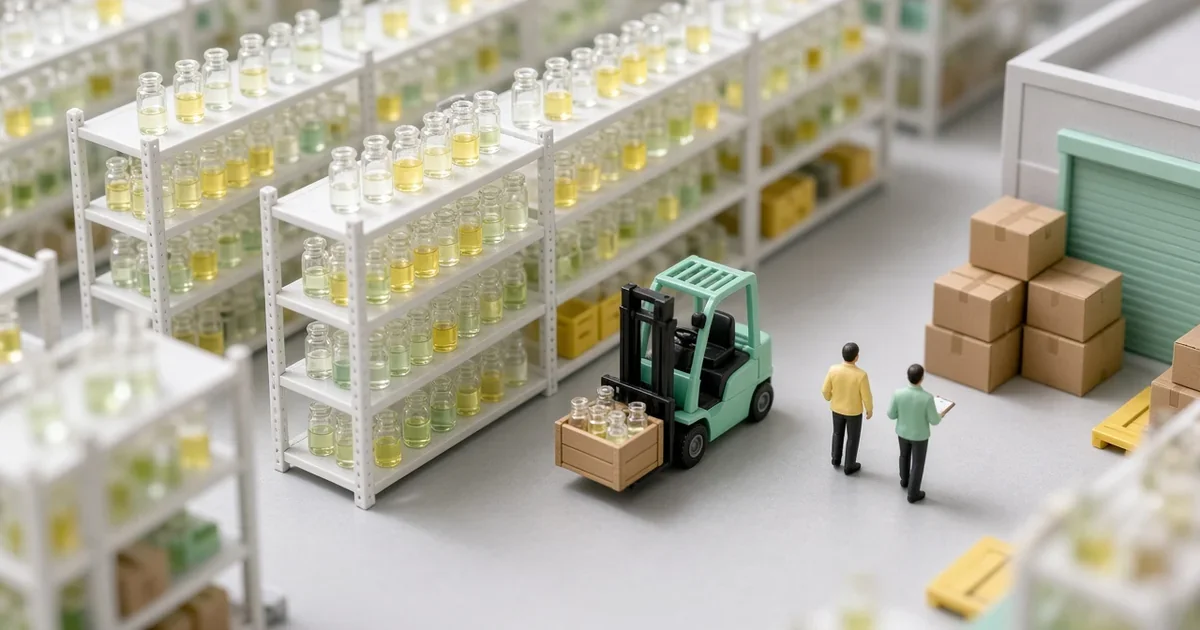
Every small perfume business eventually has the same bad morning. The order is confirmed, the beaker is tared, the formula is open, and the bottle of Iso E Super you were sure was half full turns out to be nearly empty. The batch waits, the customer waits, and you spend the afternoon on a supplier's website instead of at the bench.
Good perfume inventory management is how you stop that from happening. It isn't about fancy warehouse software. It's about knowing, in grams, what you hold, what each batch will consume and when you need to reorder. This guide walks through a simple system that works for solo perfumers and small studios alike, whether you track stock in a notebook, a spreadsheet or dedicated software.
Why Inventory Management Matters for Perfume Businesses
Perfume is unusually hard on inventory. A single formula can contain dozens of materials, some used at several percent and others at a fraction of a percent. Many come in different pack sizes, from 10 g samples to 1 kg bottles. Some are expensive naturals whose quality changes from lot to lot. And because one material often appears in many formulas, a single bottle can be drained by products you weren't even thinking about.
When stock is tracked loosely, three things go wrong:
Production stalls. One missing line out of forty is enough to stop a batch, and specialist suppliers can take days or weeks to ship.
Costs drift. If you don't know what you paid for the material in the bottle, you can't calculate an accurate cost per gram, and your margins become a guess.
Traceability disappears. If a customer reports a problem, you need to know which lot of a natural went into which batch. Without records, you can't answer.
A good inventory system solves all three with the same habit: record every gram that comes in and every gram that goes out.
What to Track in Your Perfume Inventory
Before choosing a tool, decide what deserves a line. For most small brands, there are two separate lists.
Raw materials (the list that fails first)
These are the materials that go into a formula: essential oils, absolutes, resins, aroma chemicals, bases and the solvents you dilute into, such as perfumer's alcohol or DPG. For each one, record:
Name and grade exactly as on the supplier's label, so two non-interchangeable grades never share a line
Quantity on hand in grams
Supplier and price per gram
Dilution, if you keep it pre-diluted
Lot number or purchase date, especially for naturals
A reorder point, the level that should trigger a warning
Packaging and finished goods
Bottles, caps, atomisers, labels and boxes matter too, and so do finished bottles waiting to be sold. But they behave differently: you count them in units, not grams, and they don't enter a formula. Many perfumers keep them on a separate, simpler list. That's perfectly fine. What matters is that your raw material list is accurate, because that's the one that decides whether you can make the perfume at all.
Track Stock in Grams, Not Bottles
"Two bottles of bergamot" tells you very little. A 10 ml bottle and a 100 ml bottle are both "a bottle". Perfume formulas are written in percentages and weighed in grams, so your stock should be recorded in grams too.
Weighing is also more accurate than estimating volume, because materials have different densities. If you already weigh rather than drop your dilutions, you'll recognise the logic: grams are the one unit your formula, your scale and your stock can all share.
Treat dilutions as separate materials
If you keep both neat oakmoss absolute and a 10% dilution of it, those are two physical bottles with two balances. When a formula uses the dilution, the dilution's stock goes down, not the neat material's. When you make a new batch of dilution, record it as a transfer: the neat material decreases by the grams you used and the dilution increases by the total weight you made. Mixing the two balances is one of the most common ways small studios end up "holding" material they've already poured into alcohol.
Set Reorder Points That Match Your Batches
A low-stock warning at zero is useless. By the time a bottle is empty, it's too late. A practical reorder point considers two things:
How much a typical batch uses. If your best-selling formula uses 40 g of a material per batch, a threshold below 40 g means you can't make the next batch.
How long the supplier takes to deliver. If restocking takes two weeks, your threshold should cover the batches you expect to make in those two weeks.
A simple rule of thumb: set the reorder point at the grams needed for your usual batches during the supplier's delivery time, plus a small buffer. Review the thresholds every few months, because sales patterns change and a material that was occasional can become a weekly staple.
Deduct Stock Every Time You Make a Batch
The most important moment in perfume inventory management is the batch. A formula tells you what 100% of the concentrate contains; the batch tells you how many grams you actually made. Multiply the two and you know exactly how much of each material left the shelf.
If you work in a spreadsheet, that means updating every material's balance by hand after each pour, which is exactly the step people skip when they're busy. Dedicated perfume software can do it automatically: you log the batch and the stock of every material in the formula goes down by the grams used. Our guide to scaling a perfume formula from trial to batch covers how to calculate those batch quantities in the first place.
Don't forget usage outside batches
Stock also leaves through doors that aren't batches: samples sent to clients, trial mods, spills and dilutions you prepare for the shelf. Write these down the same day. A balance that ignores them slowly drifts away from reality until nobody trusts it.
Count, Correct and Keep a History
Even with careful records, numbers drift. Evaporation, rounding and the odd forgotten sample add up. Plan a regular stock check:
Weigh the bottles you use most often, ideally once a month.
Compare the real weight with the recorded balance.
Record the correction as an adjustment, rather than silently overwriting the number.
Look for patterns. If the same material is always short, you may be missing a type of usage, or a batch may have been logged with the wrong quantity.
Keep a usage history for each material: which batches used it, how many grams each took and which lot it came from. That history is how you answer "where did the last 50 g go?", and it's your traceability record if a batch ever needs investigating. For more on the day-to-day habits behind this, see our article on raw material stock for perfumers.
Link Inventory to Your Costs
Inventory and costing are two sides of the same record. The price per gram of each material is what turns a formula into a cost, and the grams on hand tell you whether you can make it. When you buy a new lot at a different price, update the price per gram so every formula that uses it reflects the new cost.
If you want to go deeper, our guide on how to calculate the cost of a perfume formula explains how cost per gram becomes cost per bottle and a sensible selling price.
How ScentLabs Helps With Perfume Inventory Management
ScentLabs was built for exactly this workflow. Each raw material has a single record with its supplier, price per gram and dilution, and the same record is used by your formulas, so there's no second list to keep in sync. On the Pro and Lifetime plans, inventory management adds:
Stock levels in grams for every raw material
Automatic stock deduction when you log a production batch
Low-stock alerts based on the minimum threshold you set for each material
A full usage history per material
Supplier and cost tracking per ingredient
Combined with batch production, which scales a formula to your target weight and records each run, it means the moment you log a batch, your stock is up to date and your next shortage shows up before your next promise to a customer. Pro costs US$5.99 a month and Lifetime is a one-off US$49.99. The Free plan lets you set up 25 materials and 10 formulas with cost calculation, so you can organise your materials and prices before you decide to upgrade.
Frequently Asked Questions
What is perfume inventory management?
It's the process of tracking the raw materials, and often the packaging and finished stock, that a perfume business holds. For perfumers, the core is knowing how many grams of each material you have, what each batch uses and when to reorder.
Should I track perfume raw materials by weight or volume?
By weight. Formulas are weighed in grams, and materials have different densities, so grams are the only unit that matches your formula, your scale and your stock without conversion errors.
How do I set a reorder point for a fragrance material?
Estimate how many grams your usual batches consume during the time a supplier takes to deliver, then add a small buffer. Set the warning at that level rather than at zero, and review it when your sales change.
How often should I count my perfume inventory?
Many small studios weigh their most-used materials monthly and do a full count less often, for example before a big production run. Record any difference as an adjustment so your history stays honest.
Can I manage perfume inventory in a spreadsheet?
Yes, especially when you're small. The downside is that every batch must be deducted by hand. Perfume software that links formulas, batches and stock removes that step as you grow.
Get Your Materials Organised With ScentLabs Free
You can't manage stock you haven't organised. Create a free ScentLabs account, add your materials with their suppliers, dilutions and prices, and build your formulas with automatic percentages and costs. The Free plan includes 25 materials and 10 formulas, and when you're ready for automatic stock deduction and low-stock alerts, Pro and Lifetime are there to grow with your brand.